Christmas Cactus or Thanksgiving Cactus? How to Tell
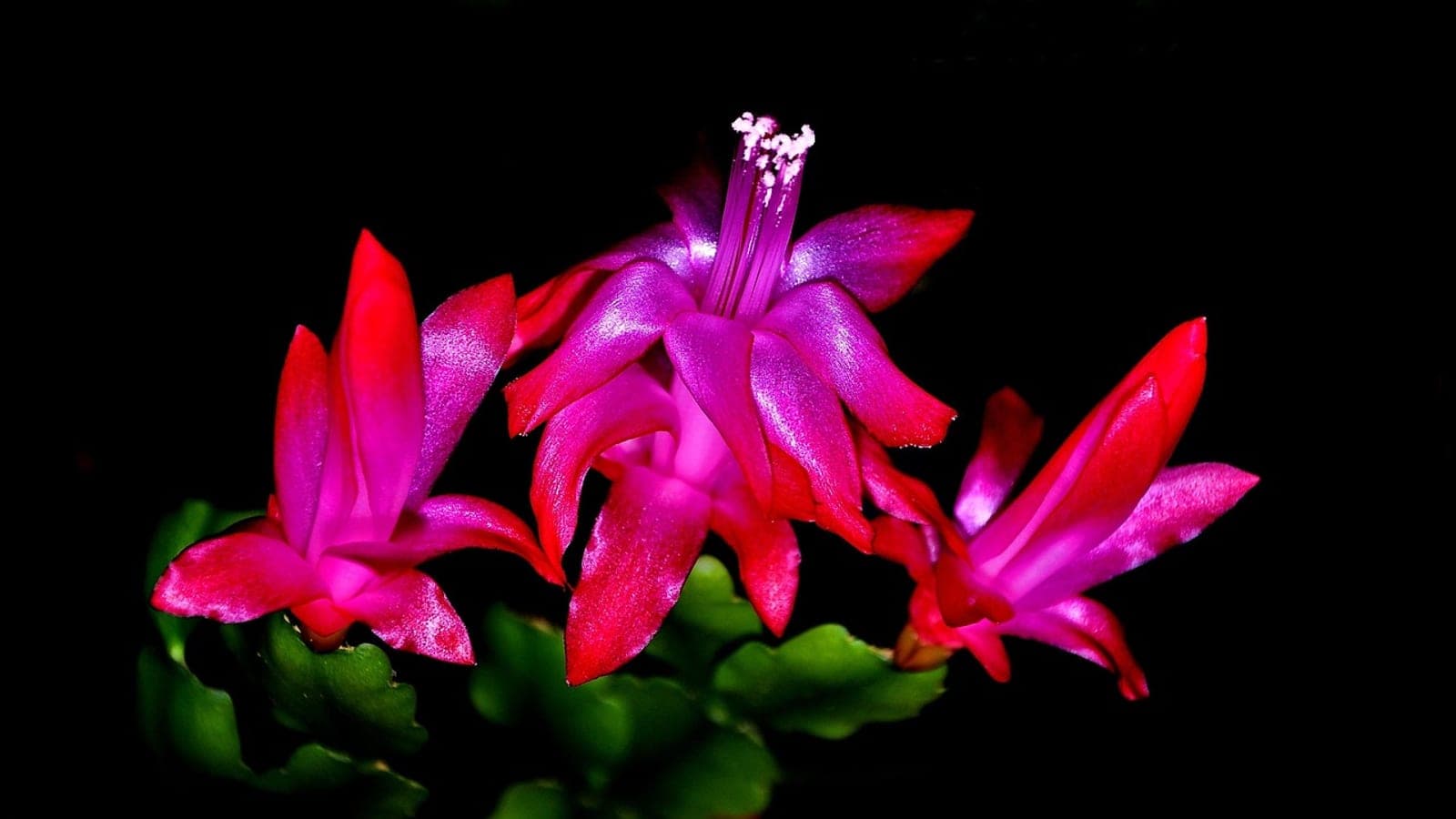
Photo by szjeno09190 on Pixabay
Run a finger along the stem segments. Pointed teeth mean Thanksgiving cactus, smooth scallops mean Christmas cactus. Here is every clue, and why it matters.
The short answer
- Run a finger along the edge of a stem segment. Pointed, saw-toothed projections mean Thanksgiving cactus. Smooth, rounded scallops mean Christmas cactus.
- Check the pollen. Yellow anthers (the little pollen tips inside the flower) mean Thanksgiving. Purplish-brown means Christmas.
- Timing helps too. The Thanksgiving cactus flowers about a month before the Christmas one.
- Most plants sold as "Christmas cactus" are really the Thanksgiving type. It hardly matters, because the care is the same.
- The Easter cactus is the third relative. It flowers in spring and has the roundest segments.
The segment edges give it away
Neither plant has leaves in the usual sense. As Clemson Cooperative Extension notes, there are no true leaves on either of these holiday cacti. What you are looking at is a chain of flattened green stem segments, each growing out of the end of the last.
Those segments are your best clue. On a Thanksgiving cactus, each one has 2 to 4 saw-toothed serrations or projections along the margins. They look like small claws or the teeth of a crab. On a Christmas cactus the edges are smooth and rounded, more like the scalloped edge of a pie crust.
Run a fingertip along one. A Thanksgiving cactus catches slightly. A Christmas cactus slides.
There is a secondary clue in the way the plants hold themselves. A Thanksgiving cactus tends to grow more upright and angular. A Christmas cactus arches and trails, which is why it looks so good in a hanging pot or on a shelf. Neither habit is a reliable test on its own, so treat shape as a tiebreaker and rely on the segment edge.
Check the flower and the timing
If yours is in bloom, look inside the flower. The same Clemson factsheet says the anthers of the Thanksgiving cactus are yellow, whereas the anthers on the Christmas cactus are purplish-brown. Anthers are the small tips on the thin stamens at the centre of the flower, which carry the pollen.
Flower shape differs a little as well. Thanksgiving flowers tend to be held more horizontally and look flared. Christmas flowers hang down and are more tubular, with petals that fold back less. Colour is no help, because both come in pink, red, orange, white, yellow and purple.
Timing is the third check. According to the same source, Thanksgiving cacti normally flower near Thanksgiving, approximately a month before Christmas cacti bloom. That is the northern hemisphere calendar. In Australia, New Zealand and South Africa the seasons run the other way, so the dates shift, but the Thanksgiving cactus still opens roughly a month ahead of the Christmas one.
If your plant flowered in late autumn and the segments have pointed teeth, you have a Thanksgiving cactus. This is the usual result for a plant bought from a supermarket or garden centre (nursery), because the Thanksgiving type is the one most growers produce.
And the Easter cactus?
The Easter cactus is the third holiday cactus people ask about. It flowers in spring rather than winter, which is the quickest way to spot it. Its segments are the roundest of the three, with soft edges and small bristles at the tips, and its flowers are star-shaped rather than hanging.
If you are comparing all three, the order is simple. Thanksgiving flowers first, Christmas follows, and Easter comes months later. When someone says their "Christmas cactus" bloomed in spring, it is usually an Easter cactus.
The three side by side
Thanksgiving cactus
Pointed, saw-toothed segment edges. Yellow pollen tips. Flowers first, around late November in the northern hemisphere. Often sold as a Christmas cactus.
Christmas cactus
Smooth, rounded, scalloped edges. Purplish-brown pollen tips. Flowers about a month later. Arching, drooping habit.
Easter cactus
The roundest segments, with bristly tips. Star-shaped flowers in spring. Needs a cool winter rest to bloom.
Does it matter which you have?
Not much for day-to-day care, which is good news if you have lost the label. Both are the same kind of plant, a tropical forest dweller that grows on trees rather than in desert sand. That is why the RHS says there are two species of Christmas cactus, Schlumbergera truncata and Schlumbergera × buckleyi. The first is what most people call the Thanksgiving cactus.
What matters is treating it as a rainforest plant. Clemson says the holiday cacti grow best in light shade, so keep them out of harsh sun. Water thoroughly, then let the top few centimetres (an inch or so) of compost (potting mix) dry out before you water again, and never leave the pot standing in a saucer of water. A cactus that is soggy at the roots yellows and drops segments, which is the pattern our guide to why a cactus turns yellow walks through, and a succulent in that state needs the steps in saving an overwatered succulent.
The real value of knowing which you have is timing. If you want blooms for a specific date, a Thanksgiving cactus will be early for Christmas and a Christmas cactus will be late for Thanksgiving. Neither is a fault.
Getting it to flower
Both plants set buds in response to long nights. Clemson states that fourteen hours or more of continuous darkness each day is required before flower bud set will occur. That means a plant in a room where the light goes on every evening may never flower, because a lamp at the wrong moment resets the clock.
In practice:
- Keep it in a room that is dark at night, or move it to a spare room or a cool porch from early autumn.
- Give it cooler nights than the rest of the house. The RHS says exact temperatures are not critical, but there should be a distinct drop.
- Once buds appear, stop moving it. Bud drop usually follows sudden changes in light, draughts, or a swing between hot days and cold nights.
- Keep the plant away from a radiator. Hot, dry air around the buds is a common reason they fall. Our guide to plants near radiators explains the effect.
Water a little less in the weeks before buds show, then return to normal watering once they are visible. If the compost dries out hard with buds on, they fall. If yours still refuses to bloom, our guide to a Christmas cactus not flowering works through the causes in order.
Which plants in your home behave like this?
Drop buds when moved or chilled
- Holiday cacti in bud
- Moving a plant from one room to another once buds are set is the classic way to lose the lot in a week.
- Orchids and gardenias
- Also drop buds when light, draughts or temperature swing, so leave them where they are once buds form.
Shrug off a change of scene
- Pothos and snake plant
- Have no flower buds to lose and tolerate being shuffled around the house.
- Holiday cacti out of bud
- Can be moved freely in spring and summer, and root easily from cuttings.
Never mind the label, check the plant
You can sort most holiday cacti with a fingertip and a look at the pollen. If you would rather not squint at segment edges in November, photograph the plant and let Folly do it. Folly identifies plants from a single photo against a database of 30,000+ species, so you get a name and a care guide without having to compare descriptions.
The full care guide is free, as are water and feed reminders and the care log, which records each watering and feed so you can see how the plant responds before and after it sets buds. If you want the watering interval worked out for you, Smart Care on Folly Pro builds each plant's schedule from more than fifteen attributes, and you can tap any plant to see every factor and the percentage it added or removed. Folly shows its working. Winter brings its own risks to every plant on your windowsill, so our guide to houseplant care in a winter with the heating on is worth a read once you have your cactus sorted.
Questions people ask
What is the easiest way to tell a Christmas cactus from a Thanksgiving cactus?
Look at the edges of the flat stem segments. A Thanksgiving cactus has pointed, saw-toothed projections along each side, like small claws. A Christmas cactus has smooth, rounded, scalloped edges. If you can only check one thing, check this.
How do the leaves of a Christmas cactus and a Thanksgiving cactus differ?
Neither plant has true leaves. What look like leaves are flattened stem segments. On a Thanksgiving cactus they are angular with pointed teeth. On a Christmas cactus they are softer and rounder, and the whole plant tends to arch and droop more.
Is the plant I bought as a Christmas cactus really a Thanksgiving cactus?
Quite possibly. Many plants sold as Christmas cactus are the Thanksgiving type, because it is easier to grow in bulk. If yours flowers around late November in the northern hemisphere and has pointed teeth on its segments, it is a Thanksgiving cactus. The care is the same either way.
What is the difference between a Christmas cactus and an Easter cactus?
The Easter cactus flowers in spring rather than winter, and its segments are the roundest of the three, with soft, bristly tips. Its flowers are star-shaped rather than hanging and tubular. Care is similar, but it wants a rest and a cooler spell in winter to flower in spring.
How do I care for a Thanksgiving cactus?
Give it bright light out of harsh sun, water when the top of the compost is dry, and let excess drain away. To flower, it needs long dark nights and cooler evenings in autumn. Once buds form, keep conditions steady and do not move the plant around.